
Alicia Pardasie Finds a Career Working with Her Hands
By Barbara Kancelbaum
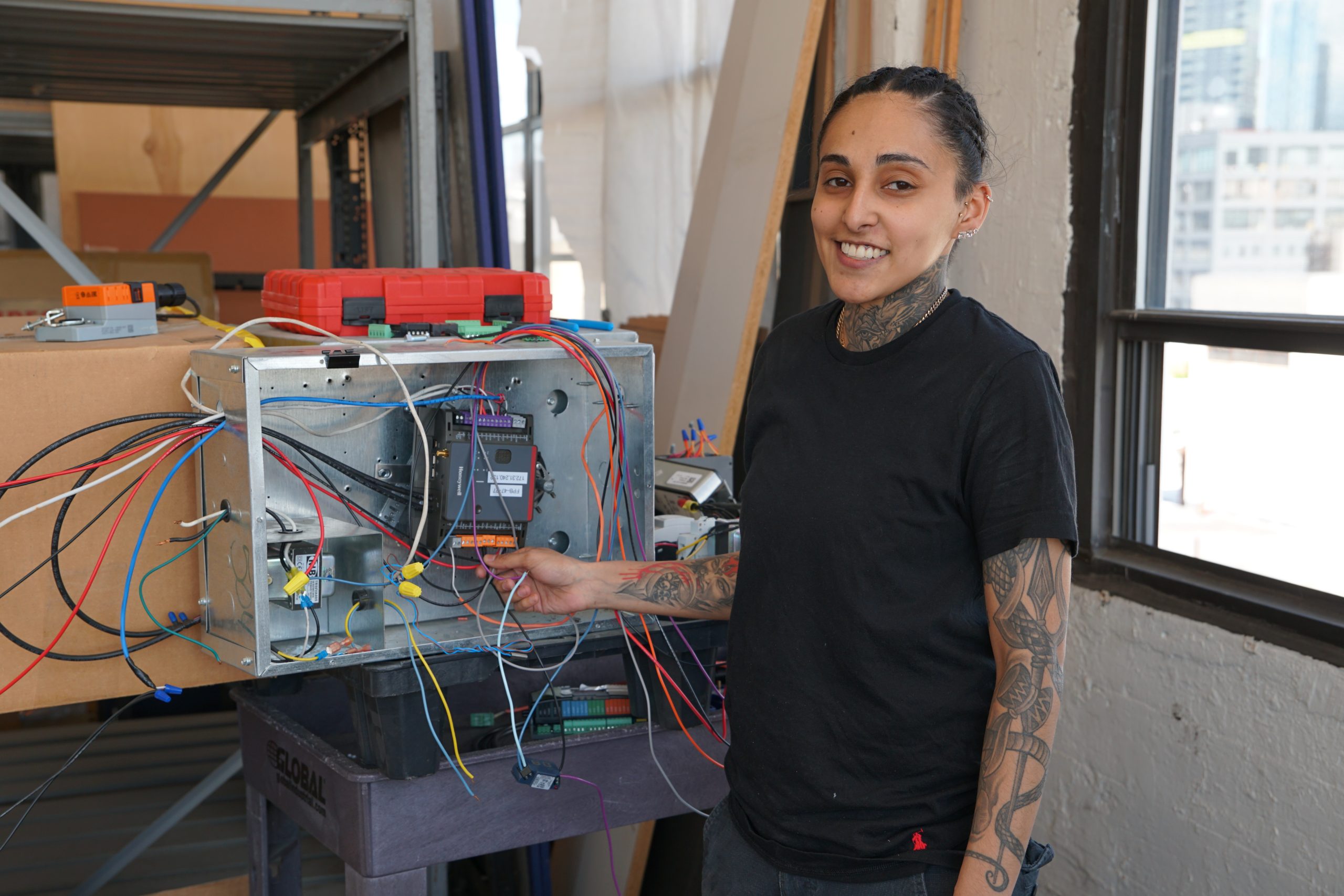
In her new job at TEC Systems, Alicia Pardasie builds and installs components that maintain an even air temperature in high-tech office buildings.
Industrious and creative, Alicia Pardasie, 24, knew as a teenager that she wanted to find a career where she could work with her hands. But, while her Queens high school offered vocational electives, she received no real career coaching or guidance toward educational pathways that would include hands-on skills.
Alicia chose an automotive elective and loved learning how to fix cars, and she still helps her relatives with oil changes and repairs. “But I knew I wanted to keep that as a hobby,” she says. Instead, after graduation, Alicia took on a series of difficult retail and warehouse roles—often working two jobs to pay the bills—a reality far too common for young people her age. In New York City, workers ages 16 to 24 face a 13.2% unemployment rate—more than 3.6 points higher than pre-pandemic levels—with young people of color hit hardest, according to the New York City comptroller’s office. Nationally, youth unemployment reached 10.8% in July 2025, with 2.5 million young people out of work. For those who do find work, low-wage service and retail jobs are often the only option.
Frustrated with an uncertain career path, Alicia decided to search online for training programs for HVAC technicians. She immediately landed on Henry Street and its partner Stacks+Joules’ Building Automation Systems (BAS) training program. Alicia applied and was accepted into the program’s 11th cohort of trainees.
“I’m very appreciative, because some of these classes, especially around coding, can cost a lot,” Alicia says. She also felt supported as a woman in a field dominated by men. “It’s very hard for a girl to get these kinds of jobs, especially with HVAC. I needed a mentor to help me work through it.”
Having completed the training in 2025, Alicia was hired in March 2026 to a full-time position as a commissioning technician with TEC Systems, a state-of-the art building technology company that has hired a dozen graduates of the BAS program.
Henry Street and Stacks+Joules teamed up in July 2021—still the height of the pandemic—to offer career training in the burgeoning, well-paying field of building automation, an industry whose products are sought by companies that want to save both energy and money.
The four-month training program was not what Alicia expected, because it involved learning how to code. “I thought we were going to take apart an AC,” she says, acknowledging that the teachers helped her through the difficult computer aspects. “Then something shifted when they showed us how to change a thermostat or fix a leak detector; that was very interesting,” she says. “That tells us where problem lies.” That moment of connection between the digital screen and physical system was a turning point for her.
The course prepared Alicia to pass the four-part EPA 608 Universal Certification Exam in refrigerant handling and to work with Niagara 4 Workbench software, used in setting up automated building functions. She also learned hands-on installation of TEC Systems components. Employees like Alicia spend most of their time in the field, working in high-rise construction or renovation sites, building or repairing the parts of HVAC systems that TEC Systems produces—such as components that ensure consistent temperature is maintained throughout a building.
“I’m very appreciative, because some of these classes, especially around coding, can cost a lot,” Alicia says. She also felt supported as a woman in a field dominated by men. “It’s very hard for a girl to get these kinds of jobs, especially with HVAC. I needed a mentor to help me work through it.”
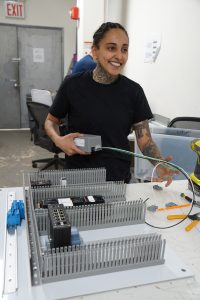
Alicia found her job at TEC Systems after taking the four-month Building Automation Systems training program co-run by Henry Street Settlement and Stacks + Joules.
Women make up just 3% of the HVAC workforce, a gap that persists across the clean energy field more broadly, where women’s representation has stalled at 32% globally. Alicia was surprised to discover that most of her teachers were women. “When I saw these women, it shocked me,” she says, adding that her class became very close, the teachers asking students to switch seats so they would get to know one another. Two of her friends now have interviews with TEC Systems.
The BAS team at Henry Street’s Workforce Development Center continues to support their graduates as they move into their careers, sharing job listings and coaching alumni through the process of finding internships and jobs.
“My family loves that I’ve done this,” Alicia says. “They were waiting for me to figure out what kind of hands-on work I wanted to do. If I hadn’t done this program, I might have been stuck in retail, and I would have been miserable.”
